Selecting the right Smart Lock manufacturers is a high-impact decision. It affects product safety, brand trust, launch speed, after-sales cost, and long-term supply stability. A smart lock is not only a piece of hardware. It is also an electronic device, a security product, and part of a smart home system.
This guide will help you choose an OEM/ODM smart lock partner with less risk. It will answer critical questions like how to check factory strength, how to judge quality control, and how to compare customization ability. If you want a partner that can support design, tooling, production, and delivery, you can also review Yongding Technology Smart Lock OEM/ODM Solutions for a real example of full-process support.
For buyers, the best smart lock supplier is not always the cheapest one. The better choice is the factory that can protect your product plan from common problems. These problems include unstable firmware, weak materials, late delivery, poor packaging, missing certificates, and unclear after-sales support. You can also browse the smart lock product list to compare typical lock types, unlocking methods, and application scenarios.
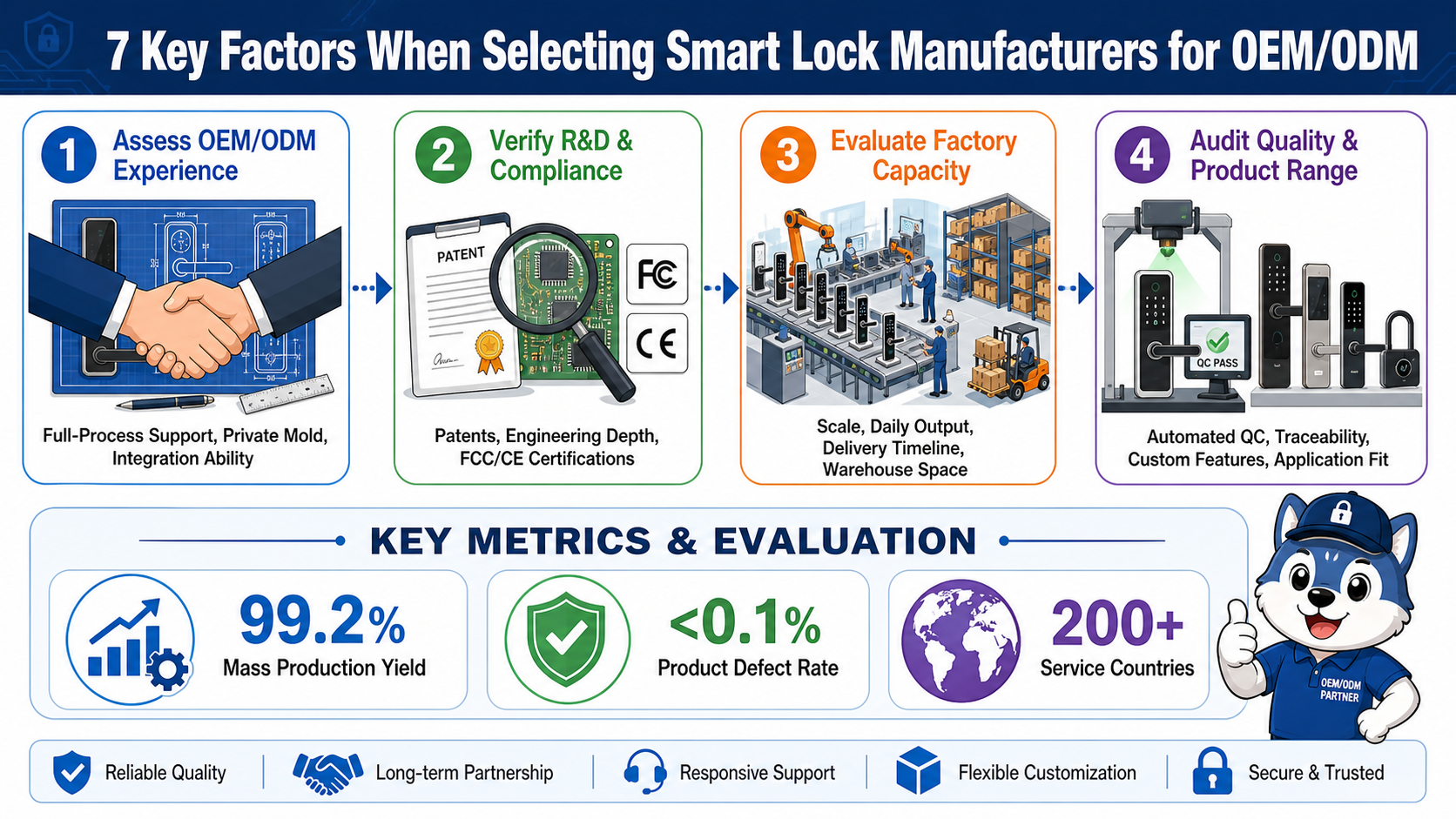
1. Check Whether the Smart Lock Manufacturer Has Real OEM/ODM Experience
OEM means the factory makes products under your brand. ODM means the factory can also help design and develop the product. For smart locks, ODM ability is very important. A smart lock needs mechanical design, PCBA hardware, embedded software, app connection, testing, packaging, and user instructions. If one part is weak, the full product can fail in the market.
A strong OEM/ODM smart lock manufacturer should support the full path from idea to mass production. This includes concept discussion, industrial design, structural design, mold development, sample making, pilot production, quality control, global logistics support, and after-sales technical help. Yongding Technology provides this kind of full-chain service for smart lock brands. Its work covers custom smart lock development, appearance design, PCBA and embedded software, app and UI customization, branded packaging, manual localization, private mold support, and integration with smart home platforms.
When you speak with a factory, ask for real project steps. Do not only ask for product photos. Ask how they handle a new lock from the first drawing to the final carton. A professional team should explain each stage clearly. They should also show how they reduce risk before mass production. This is especially important for smart deadbolt locks, smart handle locks, hotel locks, apartment locks, and office access locks.
| Evaluation Area | What to Ask | Why It Matters |
|---|---|---|
| Product Development | Can you support ID design, structure, PCBA, firmware, app, and packaging? | It lowers the need to manage many separate suppliers. |
| Private Mold | Can you develop exclusive tooling for our brand? | It helps protect product difference and market position. |
| Integration | Can you support Bluetooth, WiFi, Tuya, TTLock, API, or SDK access? | It helps the lock connect with smart home or property systems. |
| Production Path | Do you offer samples, pilot runs, and mass production? | It helps find issues before large orders begin. |
| After-Sales Support | Can your engineers help after shipment? | It reduces pressure on your brand team when users need help. |
2. Review R&D Strength, Patents, and Engineering Background
Smart locks combine several technologies. They use mechanical parts, motors, sensors, wireless modules, circuit boards, batteries, and software. This means the engineering team matters as much as the production line. A weak R&D team may copy a product shape but fail to solve real user problems. These problems may include slow fingerprint reading, short battery life, poor weather resistance, app connection failure, or unstable unlocking.
Look for smart lock manufacturers with proven technical depth. Yongding Technology has a cross-field core technology team. The team includes members with backgrounds in communication architecture, AI algorithms, and precision manufacturing. This mix is useful because smart locks must be both secure and easy to use. The company also has more than 100 domestic and international patents. Patent depth is not the only sign of quality, but it shows long-term work in product and system development.
Buyers should also ask how the factory designs for different use cases. A lock for a family entry door is different from a lock for an apartment project or a hotel project. A residential lock may need simple setup and strong battery performance. A property lock may need platform access and remote management. A hotel lock may need card access and fast guest turnover support. Good engineering teams ask these questions early. They do not push one standard model for every customer.
Smart home compatibility is another key topic. The Connectivity Standards Alliance Matter standard shows how important device interoperability has become in the smart home market. Even if your current product does not use Matter, your manufacturer should understand smart home ecosystems and future integration needs.
3. Verify Certifications and Market Compliance Before You Place a Large Order
Certification is not a decoration. It is a market access tool. If your product uses wireless functions, power circuits, or electronic control, it may need testing before it can be sold in target markets. For example, the FCC equipment authorization program is important for radio frequency devices sold in the United States. For Europe, the European Commission CE marking guidance explains that CE marking shows a product meets applicable EU requirements.
A reliable smart lock factory should understand these needs early. It should tell you which certificates are available, which tests may be needed, and which product changes may affect approval. Yongding Technology products can meet FCC and CE requirements. Several models also support FCC/FCCID certification and BHMN Level 3 security standard requirements according to the product program. The company also has ISO9001, ISO14001, QC080000, and IECQ-related certification information.
For buyers, the main lesson is simple. Do not wait until the first container is ready to discuss compliance. Build the certificate plan into the project timeline. Ask for test reports, certificate scope, model coverage, and brand label rules. Also ask whether firmware, wireless modules, or structural changes will require retesting. This helps prevent customs delays, platform listing problems, and distributor complaints.
| Requirement | Relevant Market or Use | Buyer Action |
|---|---|---|
| FCC / FCCID | United States wireless electronic products | Confirm model number, wireless module, and label requirements. |
| CE | European market product safety and conformity | Check technical file, declaration, and applicable directives. |
| ISO9001 | Factory quality management | Ask how the quality system is used on the production floor. |
| ISO14001 | Environmental management | Review how the factory controls environmental impact and process risk. |
| QC080000 / IECQ | Hazardous substance process control | Ask how materials and suppliers are controlled. |
The ISO 9001 quality management standard is widely used to manage quality systems. The ISO 14001 environmental management standard helps organizations manage environmental responsibilities. These standards are useful signals, but they should not replace factory audits. A certificate is strongest when it is supported by real process control.
4. Study the Factory Scale, Capacity, and Delivery System
Factory scale matters because smart lock orders often grow quickly after a good market launch. If your supplier cannot expand production, your brand may lose sales during peak season. But size alone is not enough. You also need stable management, clear production planning, enough testing equipment, and a good warehouse system.
Yongding Technology was established in 2002 and is positioned as a smart lock ODM manufacturer for the global market. It has a 13,000 square meter assembly factory and hardware manufacturing base, with 10 production lines and an average daily capacity of 5,000 units. Its smart factory in Shenzhen Bao'an covers 3,000 square meters. The company also has more than 6,000 square meters of warehousing area. These numbers matter because they show whether the factory can support samples, pilot orders, and larger repeat orders.
Delivery time is also part of factory strength. Yongding Technology supports sample delivery in 3-7 days, standard product delivery in 7-15 working days, and custom product delivery in 25-45 working days. For buyers, these timelines help with launch planning, distributor promises, and inventory control. Always confirm lead time by product type, order quantity, surface finish, packaging, certification needs, and peak-season load.
When comparing smart lock manufacturers, ask for a capacity plan. The factory should explain what happens when your monthly demand doubles. It should also explain how it manages component shortages. A good supply system is like a spring. It should bounce back when pressure comes. If the factory has no clear answer, your project may face late shipments later.
5. Audit Quality Control, Testing Steps, and Traceability
Quality control is the heart of smart lock manufacturing. A lock may look good in photos, but it must work every day in real homes. It must survive repeated unlocking, battery changes, temperature changes, hand contact, door movement, and sometimes outdoor conditions. Small defects can become expensive after the product reaches customers.
Yongding Technology uses 18 fully automated inspection processes to support product quality and output consistency. Its mass production yield is over 99.2%. The quality control team keeps samples from each batch and uses full-process traceability. The product defect rate is below 0.1%. These data points are important because they connect quality claims with measurable control.
Buyers should ask what is tested at each stage. Useful checks may include incoming material inspection, PCBA test, motor function test, fingerprint or keypad function test, wireless connection test, battery performance check, emergency power test, aging test, surface inspection, packing inspection, and final random inspection. For smart locks, traceability is also critical. If a problem appears in the market, you need to know which batch, which components, and which process may be involved.
Cybersecurity should also be discussed. A smart lock may connect to an app, cloud service, or property system. The NISTIR 8425 consumer IoT cybersecurity profile gives useful guidance for consumer IoT product security. You do not need to turn every purchasing meeting into a security lecture. But you should ask simple questions. How are app permissions managed? How is firmware updated? How are default passwords avoided? How is user data protected?
6. Compare Product Range, Custom Features, and Application Fit
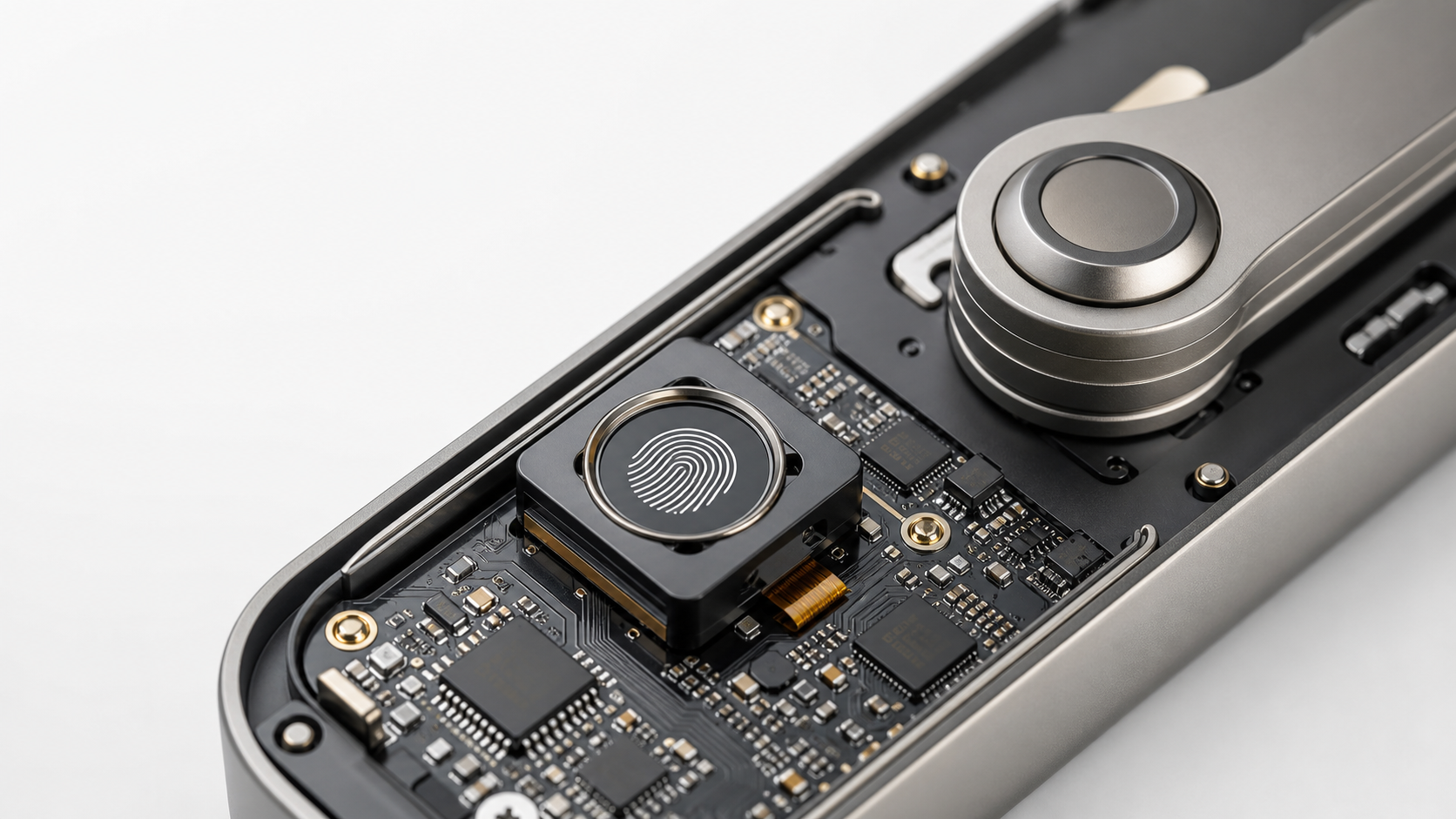
A strong smart lock supplier should not only offer one lock body. Different markets need different lock types. For example, North American homes may prefer smart deadbolts. Some modern homes may prefer smart handle locks. Apartments may need app control and user management. Hotels may need card access and simple room operations. Offices may need stronger access control and management systems.
Yongding Technology offers smart deadbolt locks, smart handle locks, and electronic handle lock solutions for residential and commercial needs. Models include DS10 MINI, DS30 MINI, DS50 MINI, G01, GC01, GC02, H1, DS70, G99 PRO, and #9 smart handle lock. Many models support operating temperatures from -25°C to 70°C. Several models use AA or AAA batteries and include a Type-C emergency power port. This feature is useful because it reduces the risk of being locked out when batteries are low.
Unlocking methods are also important. Some products support password, key, fingerprint, card, app, or a mix of these options. A buyer should not choose more functions only because they look attractive. Choose functions based on the user. A rental property may need app access. A family entry door may need fingerprint and keypad access. A low-cost product line may need password and key access. A premium product may need app, fingerprint, card, and platform integration.
Custom design also helps brands stand out. Ask the manufacturer whether it can customize color, finish, logo, packaging, manual language, app UI, and lock structure. If you need a private model, ask about tooling cost, ownership, lead time, and protection rules. For more company background and manufacturing details, you can visit the Yongding Technology about us page.
7. Evaluate Global Service, Case Feedback, and Long-Term Support
A smart lock project does not end when the goods leave the factory. Your supplier should support you before launch, during launch, and after launch. This includes technical documents, packaging checks, installation guidance, product updates, spare parts, and fast answers when problems appear. Good service can save many hidden costs.
Yongding Technology serves customers across more than 200 service countries and has worked with more than 15,000 companies. Its customer coverage includes the United States, Canada, Europe, Japan, Hong Kong, Taiwan, Central Asia, and Southeast Asia. The company has served 10K+ global customers and exported more than 50M+ products. These numbers show experience with different markets and customer needs.
Customer case feedback also matters. Yongding Technology has received ODM cooperation feedback from customers such as TCL, THORBOLT, Probrico, Knobwell, GEEK, Akagear, and Smonet. The feedback focuses on professional product design, stable structure, strict quality control, on-time delivery, fast service response, and custom solutions that match project needs. This kind of feedback is useful because it shows how the factory performs in real cooperation, not only in a sales presentation.
When you compare smart lock manufacturers, ask for proof of long-term support. Ask how the supplier handles repeat orders, firmware changes, packaging updates, quality claims, and spare part needs. A good factory should act like a long-term partner, not a one-time seller. This is especially important if you plan to build a product line for several years.
Practical Buyer Checklist Before Choosing Smart Lock Manufacturers
Before making a final decision, use a simple checklist. It helps your team compare suppliers in the same way. This is useful when engineering, purchasing, sales, and management all join the decision. It also helps avoid choosing a factory only because of a low unit price.
- Confirm OEM/ODM scope: Check whether the factory can support design, engineering, tooling, production, packaging, and after-sales service.
- Check certificates: Review FCC, CE, ISO9001, ISO14001, QC080000, IECQ, and product-specific certificate needs.
- Audit quality control: Ask for testing steps, inspection records, batch traceability, and defect data.
- Review capacity: Compare factory area, production lines, daily output, warehouse space, and peak-season planning.
- Test real samples: Check unlocking speed, app connection, battery behavior, emergency power, installation, and user experience.
- Study service response: Confirm who answers technical questions and how fast they respond after shipment.
You may also review the UL 294 access control system testing information if your project involves access control system units. Not every residential smart lock needs the same standard. Still, it is useful to understand how professional access control products are tested for reliability and function.
Frequently Asked Questions
How long does it usually take to get smart lock samples and custom products?
Samples can be ready in 3-7 days based on Yongding Technology's stated delivery support. Standard products usually take 7-15 working days. Custom products usually take 25-45 working days. The final time depends on the lock model, customization level, tooling needs, packaging, and order size.
What quality control process should I expect from a smart lock ODM factory?
You should expect clear inspection steps and batch traceability. Yongding Technology uses 18 fully automated inspection processes. Its quality team keeps samples from each batch and applies full-process traceability. The company states a mass production yield above 99.2% and a product defect rate below 0.1%.
Can a smart lock supplier support app, Bluetooth, WiFi, Tuya, TTLock, API, and SDK integration?
Yes, if the supplier has full ODM development ability. Yongding Technology supports fingerprint, password, RFID, Bluetooth, WiFi, Tuya, TTLock, API, SDK, third-party smart home platform integration, property management system integration, and access control ecosystem integration based on project needs.
What factory scale is useful for stable smart lock mass production?
A useful factory scale should support pilot runs and repeat mass production. Yongding Technology has a 13,000 square meter assembly factory and hardware manufacturing base, 10 production lines, and an average daily capacity of 5,000 units. It also has more than 6,000 square meters of warehouse space.
Conclusion: Choose a Smart Lock Manufacturer That Reduces Risk, Not Only Cost
The best smart lock manufacturer should help you launch a product that is safe, stable, attractive, and ready for your target market. Price matters, but it should not be the only factor. You should also review ODM ability, R&D strength, certificates, factory capacity, quality control, product range, and long-term support.
Yongding Technology brings smart lock R&D, OEM/ODM customization, manufacturing, quality control, and global delivery support into one service path. If you are building a new smart lock product line or upgrading an existing one, visit the Yongding Technology homepage or explore its smart lock products to start your supplier evaluation.